


.png)
Boston Dynamics’ Robot Dog Could Change Delivery Work—But Is It Replacing Drivers?

So recently, I got an email from one of my subscribers, Jennifer Montgomery. Jennifer, thank you so much for emailing me about this and helping make this video possible.
Jennifer raised the concern that Boston Dynamics may be developing Spot to replace delivery drivers. This is not normally a topic I cover, but the demonstration is worth examining because of what it could eventually mean for delivery work.
So in this article, We are talking about:
How Boston Dynamics is testing Spot for package delivery
The concern Jennifer raised, what the video shows, and how it ACTUALLY works
Everything in between!
Disclaimer: The content of this article does not contain and is never intended to be legal, business, financial, tax, or health advice of any kind. This article is for entertainment, educational, and informational purposes only. It is advised that you conduct your own research and consult with qualified professionals before applying anything you find online.
I also want to be clear that everything we are going to go over is very market dependent, and what applies to me and my market may not apply to you.
The Video
This video was sent to me by Jennifer Montgomery and it is available on Boston Dynamics YouTube channel.
Before we go any further, this is currently a demonstration—not an active delivery program. Boston Dynamics says it is speaking with major logistics companies and wants to develop a full pilot, but it has not identified a delivery partner or announced a public rollout.
The Driver Is Still Part of the Workflow
The first thing we should clarify is that this demonstration does not completely remove the human driver from the delivery process.
According to Boston Dynamics, the driver would load two packages onto Spot and could then prepare the next set of deliveries—or personally deliver other packages—while Spot walks to the designated homes. That is different from someone manually controlling the robot every second, but it is also very different from eliminating the driver.
The driver still has to locate the correct packages, make sure they are loaded in the correct order and deal with anything that does not go according to plan. In its current form, Spot looks more like another piece of equipment that the driver must manage than an independent delivery worker.
That also creates an important question about what happens when multiple Spot robots are assigned to the same route.
Suppose a driver spends time teaching one Spot where certain homes are located, where customers want their packages placed and which pathways the robot should avoid. What happens when that particular unit is removed for repairs, maintenance or charging and replaced with another one?
Boston Dynamics already has a fleet-management system called Orbit that can centrally store missions and information from multiple Spot robots, so that may solve part of the problem. However, its delivery explanation does not tell us whether residential routes, customer preferences and delivery instructions learned by one Spot would automatically transfer to another unit.
If two nearly identical Spot robots were switched without the driver realizing it, the driver might think the system keeps forgetting the same information. Imagine repeatedly entering instructions for the same houses because the robot assigned to you that day does not have access to what the previous robot learned. That would become irritating very quickly, especially during a route where every wasted minute matters.
For this system to genuinely help drivers, the delivery information needs to follow the route, vehicle or driver—not remain trapped inside one individual robot. Drivers would also need to be clearly notified whenever equipment is switched.
That does not make the concept impossible, but it shows that the software, data sharing and communication surrounding Spot will be just as important as the robot’s ability to walk a package to someone’s porch.
Dog-Like Design, Not Car-Like Design
This type of design is common for Boston Dynamics. Spot’s limbs and body resemble a dog, unlike the small, car-like sidewalk delivery robots being tested by DoorDash and Uber Eats.

Or like the Drones being tested by Doordash in Washington.
That makes the design normal for Boston Dynamics, but very different from what gig workers usually encounter.
The dog-like design may help Spot navigate difficult terrain, but the way it actually handles a delivery creates another set of questions.
Questionable Package Handling
To Boston Dynamics’ credit, the company has apparently thought more about the package drop than the demonstration alone shows.
According to its website, the conveyor system would use stop sensors to separate the packages and a small tray that moves forward to reduce the distance and speed of the drop. Boston Dynamics also claims that it successfully tested the system with a carton of eggs.
That is helpful information, and it addresses some of my initial concerns. However, successfully delivering eggs during a controlled test is not the same thing as completing hundreds of real deliveries under unpredictable conditions.
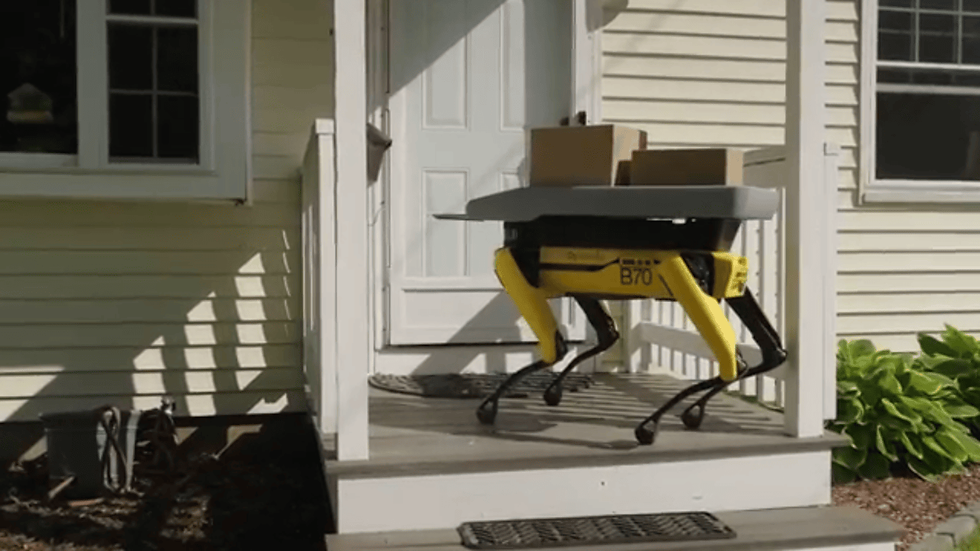
What happens if a package is already crushed, partially open, wet or leaking when it is loaded? What happens with a soft envelope that does not sit evenly on the conveyor, or an irregularly shaped package that begins shifting while Spot walks?
If two packages are loaded, how does the system confirm that the correct package is released at the correct address? Is each package scanned and digitally assigned to its position on the conveyor? What happens if the packages shift and switch positions during the route?
There also needs to be a way for Spot to recognize when a package falls off before reaching the customer. Does the robot stop immediately? Does it alert the driver? Can it pick the package back up, or would the driver have to abandon what they are doing and go recover it?
Then there is the actual placement at the customer’s home. Delivery drivers do more than get a package somewhere near the front door. We look for protection from rain, avoid blocking outward-opening doors, keep packages out of direct street view and follow customer instructions whenever possible.
Can Spot understand those differences? Can it recognize that placing a package directly in front of a storm door could trap the customer inside? Can it move a delivery under an awning when it starts raining? Can it tell the difference between a front door, side door and garage entrance?
What happens at gated communities, apartment buildings, elevators or homes with loose animals? What does it do with signature-required packages, age-restricted products or deliveries where the customer must provide a code? If the robot cannot complete the delivery safely, does it return the package to the vehicle or leave it somewhere else?
Proof of delivery matters as well. Would Spot take a photograph showing exactly where the package was placed? Would the driver receive confirmation that the correct package reached the correct address? If a customer later reports damage or claims the package was never delivered, who is responsible for reviewing that information?
These questions become even more complicated when we move outside ordinary parcel delivery and into gig work. Food bags, drink carriers, grocery orders and meal-kit boxes are not always sealed or evenly balanced. Some leak, some tip over and some must remain upright throughout the entire trip. A conveyor that works with a sealed cardboard box may not work safely with four fountain drinks and a paper restaurant bag.
From a development perspective, the system may eventually need adjustable barriers, weight and position sensors, waterproof surfaces, package-verification scans, proof-of-delivery cameras and a way for drivers to mark certain items as unsuitable for robotic delivery. Drivers also need an immediate override whenever the situation does not match what the robot was designed to handle.
The softer delivery mechanism answers one concern, but it does not resolve the entire chain of custody. The real test will not be whether Spot can deliver one carton of eggs during a demonstration. It will be whether it can safely handle hundreds of imperfect packages, customer instructions and unexpected situations during a real working route.
Robot Assistant, Not Replacement
At this stage, Boston Dynamics is presenting Spot as a tool that would work alongside a driver—not as a system ready to remove the driver completely. But the public reaction shows there are still plenty of questions about whether the additional cost and complexity would be worth it.
Stealing the Robot Dog

MrJeffTTV: Nobody has the intention of abducting the 50k robot dog that delivers ur Amazon packages
I think it would be much harder to steal a robot dog than a package, but I definitely see how that would be possible. I also see how someone would keep trackers on it in case that would happen.
After all, this cannot be reasonably priced to manufacture this thing.

tomich20:
2025: steal amazon packages
2026: steal amazons delivery bots
To be honest, I can absolutely see people trying to steal one so they can figure out how to hack it. Like if 2026 would be stealing delivery robots, 2027 would be hacking them remotely and then taking all the packages that way.
Then the other challenge would be to find how to deal with the driver, but I am going to stop talking now because this sounds like conspiracy and I don’t want to be accused of inspiring crime.
Stealing is wrong people.
An Unnecessary Addition?

Markomus: Proof that proof of concept =/= proof of necessity
I don’t know about that, there wasn’t a necessity for food delivery and then pizzas started getting delivered, and that was before the apps got developed and we are in the world we are in today.
Not that it ACTUALLY is a necessity (well except during the COVID-19 Pandemic) but nowadays, it wasn't for a long time and then people started treating it as part of their everyday life. So you don’t know if that will stay the case long term.
Not to mention that people will always value convenience and optimization over anything else.

Victoriaq5157: And the human cannot put the box on the porch because . . . . . ?
Human’s can, but it would be easier if more machines would be able to handle some areas while you just load the others. Or perhaps several Spot units could handle different homes while the driver continues loading and coordinating them?
This may be making just as much work as it is relieving but it does also relieve a lot of the heavy lifting that you would be forced to do if you didn’t.
Like it might be a bit more work to load the packages onto a handtruck, but it helps you move the packages more effectively without hurting yourself. Same principle for the dog, except it even relieves more of the work for you.
Robot Phobia?

MDMXGames: As someone who mistreats robots professionally, this felt like a personal attack
I feel like when robots and a.i. become more integrated into society, this type of comment is going to get you put on some kind of list.
I understand how a lot of people are intimidated by these kinds of news as a threat to their jobs, it can also open opportunities as well.
Regardless, if these robots ever gain sentience, I don’t want to be on the wrong end of something that can hurt me more than I can hurt it.

FairuzaMNasir: so delivery job requirements now include navigating RC machinary?
I would assume this would be a specialized position, not something an average UPS driver would have. The way I would see it is a driver has a bunch of packages going to one neighborhood and loads and deploys a bunch of these.
That assumes a lot though so who knows. Maybe that would replace drivers in a few decades but not today in my opinion.
An Unwise Investment?

ZeroPointAlpha: I personally find it hard to believe that delivery companies would sacrifice cargo space for a robot.
Yeah, this is why I am thinking this is a LONG ways away from being something that will immediately replace people. Right now, companies are trying to maximize load space so they can make the most of a single trailer or truck, and there isn’t as much room for equipment as one may think.
Not to mention, I don’t know if they would trust an average driver with such expensive equipment. Which is why I think it would create specialized positions for this to pilot it before making this happen.

A13banger: That slide off one box, then go next door and slide off another box is something that only works in this demo lol but its cool
Yeah, this is why I simply refuse to believe this would replace drivers, at least in the more immediate future. Imagine someone’s fragile package broke or in the case of food delivery, the bag wasn’t sealed right so it spills.
If it is something like Veho or some other platform that uses gig workers and delivers meal kits, there are times when the bag or box is leaking so it would damage the bot or rip open upon delivery.
Which is why human hands are going to be necessary for average gig work.
No Immediate Threat to Most Gig Workers
Based on what Boston Dynamics is presenting today, Spot appears to be designed to work alongside delivery drivers—not completely replace them.
The company describes Spot as a robotic partner that could carry packages from the van to nearby homes while the driver prepares additional packages or makes other deliveries. That could reduce some of the walking and physical strain placed on drivers, especially in neighborhoods with long driveways, stairs or difficult terrain.
However, working alongside drivers does not necessarily mean the technology will have no effect on their jobs.
If companies decide that one driver can complete significantly more deliveries with several Spot robots, they may increase route sizes and productivity requirements. Boston Dynamics has suggested that for every three packages delivered through Spot, another package could potentially be added to the van. In other words, the driver may receive assistance—but the company may also expect more work in return.
Those may be common medium-sized parcels inside a traditional delivery van, but gig workers regularly transport items that fall outside that format—including envelopes, oversized grocery orders, unsealed food bags and drink carriers that must remain upright.
Boston Dynamics says Spot can carry two 16-by-12-by-10-inch parcels and believes parcels of that size could represent at least 60% of the packages inside an average delivery van.
My channel primarily serves gig workers, and this system does not translate directly into the work performed through platforms such as DoorDash, Uber Eats, Instacart or other local delivery services.
Gig workers do not simply pull standardized boxes from an organized delivery van. We enter restaurants and stores, verify orders, handle delays, transport hot and cold items, protect drinks from spilling, communicate with customers and deal with apartment buildings, access codes and constantly changing pickup locations.
A robot capable of carrying two cardboard boxes does not automatically solve those parts of the job.
That is why I do not see Spot as an immediate replacement threat to the average gig worker. It may eventually become a useful assistant in certain package-delivery environments, but assisting a parcel driver and independently completing an entire gig-app order are two very different challenges.
Still, drivers should pay attention to how this technology affects route expectations, compensation and staffing. A robot does not have to replace every driver to change how companies value—and measure—the humans still doing the work.
How Autonomous Is Spot, Really?
According to Boston Dynamics’ website, the first deliveries may involve a driver manually guiding Spot through a route. That route could then be saved, allowing the robot to return to known addresses more autonomously in the future. The company also says remote operators may initially remain available to intervene if Spot becomes stuck.
I want to be clear that I have not personally operated this system or watched it complete a real delivery route, so I cannot independently confirm or deny how well that process works.
That does not automatically mean Boston Dynamics is lying. It means the information is coming from the company developing and marketing the product. A controlled demonstration is designed to show us the system working under favorable conditions—not necessarily every failure, intervention or inconvenience that occurred behind the scenes.
The claims could be completely accurate, or they could represent what the company expects the finished system to accomplish after additional development. Until independent drivers test it under real working conditions, we should treat the video as a proof of concept rather than proof that the entire delivery system is ready.
There are also significant differences between teaching Spot a repeatable industrial inspection route and sending it to constantly changing residential addresses.
How much time does the driver spend introducing Spot to a new home before the robot can return autonomously? What happens when the next delivery route contains addresses the system has never seen before? Saved routes are helpful when a robot repeatedly visits the same locations, but delivery drivers may encounter new customers every day.
What happens when a customer moves a trash can into the walkway, construction blocks the normal path or a parked vehicle changes the environment? How does Spot respond to children, pets, sprinklers, damaged sidewalks, poor lighting or sudden weather conditions?
How frequently does a remote operator have to intervene? If someone must remotely rescue the robot several times during every route, the system may simply move labor from the delivery vehicle into a control center.
We would also need to know what happens when the robot loses its connection, runs low on battery or experiences a sensor problem halfway to a house. Does it stop where it is? Return to the vehicle? Alert the driver? What happens to the packages while everyone is trying to resolve the problem?
The most meaningful numbers will not come from one polished demonstration. They will come from real pilot programs showing how many deliveries Spot completes, how often humans intervene, how long new routes take to configure and how many packages must still be recovered by the driver.
Until we have that information, we know what Boston Dynamics says Spot can do—but we do not yet know how reliably it can do it during an average driver’s working day.
Autonomous Vehicles Still Need a Complete Delivery System
Boston Dynamics has also discussed the possibility of autonomous vehicles eventually transporting entire fleets of Spot robots.
That sounds much closer to a future where human drivers are removed, but transporting the robots is only one part of the delivery process. Making the vehicle autonomous does not automatically load the correct packages onto the correct Spot.
In the demonstration we have today, a human still pulls the packages from the vehicle and places two of them onto the robot. Boston Dynamics has suggested that ceiling-mounted robotic arms could eventually stage packages automatically, but that is another technology layer that still needs to be developed, tested and integrated into the delivery vehicle.
The system would need to identify every package, determine the delivery order, place the correct two packages onto each Spot and verify that nothing was damaged, misplaced or loaded backwards. It would also need a plan for rejected deliveries, customer disputes, missing packages and anything the robot could not safely complete.
Spot currently carries only two parcels at a time. That capacity could improve in the future, but using several Spot robots would also take up cargo space, add weight and create additional charging and maintenance requirements inside the vehicle.
If one unit breaks down, another robot may need to take over its packages and route information without disrupting every other delivery. Otherwise, the technology intended to save time could create a new logistical bottleneck.
The gap becomes even larger when we apply this idea to gig platforms as they operate today. An autonomous vehicle carrying several Spot robots cannot walk into a busy restaurant, find out why an order is missing, verify a customer’s groceries, protect a drink carrier or resolve a problem with an employee.
Could other machines eventually perform some of those tasks? Absolutely. Technology will continue changing, and it would be foolish to pretend that today’s limitations will exist forever.
But that day is not today. Boston Dynamics has demonstrated one robot carrying two packages from a vehicle to two homes. That is an interesting step toward delivery automation, but it is still a very long way from autonomously completing the unpredictable, end-to-end work currently performed by gig workers.
Final Thoughts
I know what the hater brigade that shows up whenever gig workers talk about making decent tips would like us to believe—that we will all be replaced in the near future—but it is way too soon to reach that conclusion.
Everything we have examined points to the same reality: integrating multiple Spot robots into the workflow of an average driver would be a HUGE logistical challenge. Spot may eventually change certain parts of delivery work and increase productivity expectations, but Boston Dynamics has not demonstrated a system that is ready to remove the average driver.
That said, drivers should not ignore how this technology may change the industry. Save your money, invest carefully, diversify your income, and develop an exit strategy that does not depend on delivery work long term.
No one is going to look out for your financial security more than you are.
If you would like to add some other perspective to how Spot may or may not be added to delivery workflow, feel free to email me: drivenwyld@gmail.com and who knows? Maybe your email or perspective and be featured in a post as well!


Comments