


.png)
Red Card Abuse Violations on Doordash - EVERYTHING You MUST Know!!
- Joseph Mandracchia

- Nov 11, 2025
- 14 min read
DoorDash has quietly rolled out a new wave of Red Card Abuse Violations, and drivers across the country are getting hit with contract violations for things that often aren’t their fault. From price mismatches and POS glitches to substitution issues and digital payment errors, these violations are becoming one of the fastest ways drivers end up at risk of deactivation.
In this breakdown, we’ll take a clear look at how these Red Card “overcharge” violations really work, what’s triggering them, why the appeal system rarely helps, and how this policy shift affects drivers, merchants, and customers. If you use the Red Card — or you’re trying to understand why drivers are avoiding Red Card orders entirely — this is everything you need to know to protect yourself in today’s gig economy.
So in this article, We are talking about:
EVERYTHING You MUST Know about Red Card Abuse Violations on Doordash
What Doordash is saying vs How it ACTUALLY is
Everything in between!
Disclaimer: The content of this article does not contain and is never intended to be legal, business, financial, tax, or health advice of any kind, This article is for entertainment purposes only. It is advised that you conduct your own research and consult with qualified professionals before applying anything you find online.
I also want to be clear that everything we are going to go over is very market dependent, and what applies to me and my market may not apply to you.
What Doordash Tells You
This is a policy that you can only find in the “Dasher Contract Violations FAQ”, under the Red Card Abuse Violations section.
This Policy ensures that instances of Red Card Abuse (RCAB) fraud committed by DoorDash Dashers are identified and addressed, upholding standards of trustworthiness, accountability, and transparency in our delivery operations.

Oh, that is some BS, here let me fix that real quick:
Doordash BS Translator: This Policy ensures that instances of us being charged more than what we expected is punished, not to ourselves or the merchants for setting the prices, but to lowly drivers who are just trying to fulfill the order.
We need to have some reason to wrongfully deactivate drivers and this gives us a papertrail to do so.
Yeah, that is much better.
Dashers who are onboard on the platform have access to a physical or virtual Mastercard called Red Card, which is used to shop on behalf of Customers. During Dasher Shop and Deliver (DSD) or Dasher Shop and Stage (DSS) orders.
As if I needed another reason to never conduct a shopping order on a platform that is looking for new reasons to blame the driver for things outside of the drivers control?
Dashers can use the Red Card to commit overcharge fraud by:
Red Card Over Swipes/Extra Swipe: Dasher uses Red Card to purchase items other than/ in addition to what the Customer orders by swiping more than the expected amount and/or swiping multiple times.
Okay, this one I understand. This seems to be combatting a few specific kinds of drivers and customers.
Drivers who add items to the order and keep the items for themselves, therefore putting the cost upon the customer.
Drivers who blindly follow customers' substitution requests even though it is clearly a sign of them trying to scam the system.
Customers who place orders knowing it will force a substitution and telling the driver to replace the item with ONLY in-app options, which tend to lead to gross overcharges, especially when it is completely unrelated to the original item.
Red Card Swipe/Unassign: Dasher swipes the red card and unassigns themselves from the order / cancels order without intent to deliver.
This is just theft, like this is simply theft, there is no other reasonable explanation here. Why bother with the order in the first place?
You’ll receive these notices when you overswipe/ add extra items without Cx approval and/or Swipe and Unassign without a valid reason on a Dasher Shop and deliver order. It will appear in your Rating tab as a “Red Card overcharged” or “Unassign/Cancelling after using Red Card” Contract Violation.
Okay but these aren’t the ONLY reasons you would see the card be marked as overcharged.
What about instances where they raised the prices in the store, but didn’t apply them to the Doordash platform?
What about when you actually need to replace them with things that actually make sense but the price is higher?
We are already seeing instances where people are getting violations for overcharging and it is simply a couple of bucks difference, or in one recent case literally nothing! Not to mention, when he did the deep work of inquiring about it later, he discovered that wasn’t the reason at all!
Which then begs the question, why have a universal violation screen on something that is multifaceted like that? Why mislead a driver into thinking it was an overcharge when in reality it was a completely different aspect of the same subject?
Violations vs Ratings (What Actually Matters)
Before we go any further, I want to make something very clear, because a lot of drivers get these two things mixed up:
Ratings and violations are NOT the same thing.
A bad rating?
That’s annoying, but it’s measurable and controllable.
You can recover from it. You can manage it. And honestly, nine times out of ten, it doesn’t affect your ability to make money in the long run.
A violation, though?
That’s a completely different story.
Violations are what drivers are actually scared of, because violations can and do lead to deactivation.
And here’s the kicker: Doordash knows this.
That’s why so many violations are vague, automated, and one-size-fits-nothing. They carry more psychological weight. They make drivers second-guess themselves. They create fear, even when the driver did nothing wrong.
And no — I’m not going to sit here and pretend that violations are tied to Top Dasher or Platinum programs. They aren’t. And honestly, those programs were never the point anyway.
Like I say in every one of my videos:
Do not let Doordash “teach you how to dash.”
Those badges and statuses are designed to make them more profitable, not you.
But violations?
Those are different. Violations bypass the whole “teaching” part and go straight for the throat. They threaten your access to the platform. They threaten your income. And they put all the risk on the driver.
So when Doordash starts adding new Red Card violations — especially ones that punish drivers for things completely outside of their control — that’s why it hits harder.
Not because of statuses.
Not because of ratings.
But because violations are the fast-track path to deactivation, and drivers know it.
All Violations Carry Weight
And this brings us to the next part that a lot of drivers don’t fully realize…
Drivers don’t sit around ranking which violations “matter more.”
They worry about all of them — because every violation is tied to the same outcome:
it can be used as grounds for deactivation.
There is no “safe” violation.
There is no “low-tier” violation.
Ratings can get you deactivated in some cases, but they’re at least measurable, trackable, and recoverable. Violations don’t work that way.
A single violation can trigger:
an account review
a temporary pause
an automated account hold
or an outright deactivation
So the point isn’t whether Red Card violations matter more than anything else, It’s that they get grouped into the same bucket of risk.
Once a violation is on your account, there’s no transparency about how Doordash weighs it, tracks it, or chooses to enforce it.
That’s why drivers treat every violation with the same level of fear —
not because they’re dramatic,
but because any one of them can be the one that gets you kicked off the platform.
This keeps the message accurate and aligned with what drivers actually experience.
The Appeal System Isn’t a Safeguard — It’s a Wall
Before anyone says, “Well you can always appeal it,” let me shut that down right now.
Yes, technically you can appeal contract violations in a lot of cases, anyone who has actually tried knows how this goes:
Your appeal gets reviewed by AI first
Then “a specialist” — which might as well be another AI — rubber stamps it
You get a template denial that explains nothing
Or no explanation at all
Or you get told they “thoroughly reviewed your case” without them addressing anything you actually wrote
It’s not a review system, It’s a wall.
That’s exactly why drivers are so scared of violations compared to ratings. Ratings can be fixed. Ratings have a recovery path. Violations go straight into a black hole where a bot decides your fate.
Potential Legal Strategy
In my opinion, it feels like they are pre-emptively preparing to increase costs upon the driver for when they inevitably cause deactivation and when some of them sue and it leads to arbitration, they have to fight this point and it will only lead to a back and forth, increasing the costs on the driver from a legal standpoint.
At what point does fighting back against this kind of violation become financially unbearable? When you’re drafting arguments for legal battles, think of each motion as a financial punch.
A single motion can cost a client THOUSANDS of dollars in legal fees and those costs can add up quickly.
You might consider lawyers who would work on contingency, but we have already seen in various cases how most attorneys will just not take a case because the upside isn’t there and they are a business too, so they have to think about how much profit they can make from this kind of case.
Not to mention that most drivers work on Doordash because they need to make ends meet, so fighting back legally isn’t financially feasible, so there are already various gaps to consider when considering legal representation.
Which is why this also seems to be designed as pre-emptive legal defense through pricing out those who can’t fight back.
Can You ACTUALLY Overcharge the Red Card?

In most cases, no. You would have to call it in and see if support will add more to the card. Sometimes they will do that, sometimes they will say no and cancel the order, and sometimes they will ask you to pay for it and “get reimbursed later”.
Never pay for an order out of pocket by the way, that is 100% a nightmare and I have FOUGHT FOR WEEKS trying to get money back.
But this goes to show that you shouldn’t even do that anymore because what the net results will be is you getting a violation and a headache.
QR Code Scan Risk
In a reddit post I found while doing research on this subject, I found a post where someone was given a Red card violation for overcharging $0.00. Later he found out that he was given that violation for “swiping too many times” even though he scanned a QR code to pay for it via Red card.
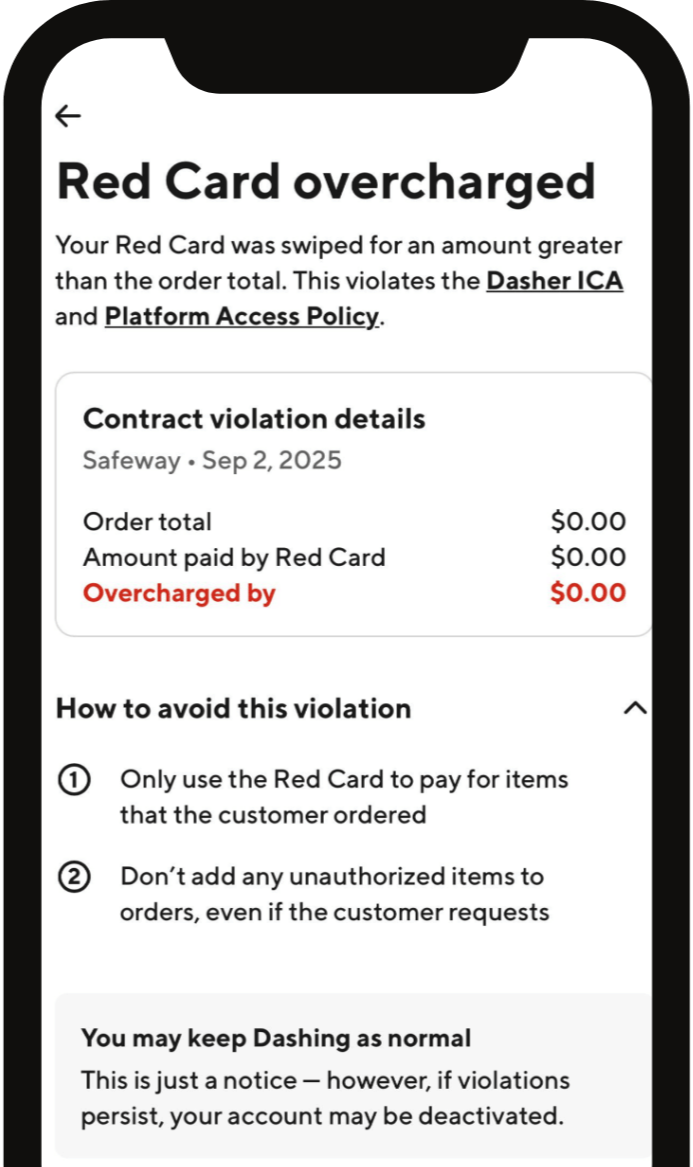
This tells me that the digital payment system is either double-processing transactions or failing to sync properly between merchant POS systems and the Doordash payment gateway.
I have always been a physical card kind of person myself but for people who prefer to just keep all of their work on their phone, they have to be punished for that? What?
That said, this can just be an early game glitch and not going to stay like this. But then again, Doordash isn’t exactly known for fixing problems, more like weaponizing them or creating new ones.
Substitutions Scams
Out of all of this, this might be one of the more positive results of this kind of violation and that is ceasing the substitution scam problem.
If drivers are becoming more concerned about getting these kinds of violations, you will have less drivers just blindly accepting what other customers are saying and doing in terms of trying to get one over on the system.
You will have more people thinking about their customers' actions rather than just accepting what they say at face value.
Just a quick recap of what a substitution scam is, it is when they intentionally order something that will inevitably lead to forcing a substitution, such as deli meats in a grocery store that is closing their deli and substituting it for a higher value item such as Diapers.
They use a prepaid visa card to pay for it as a Doordash customer and when the card gets overdrafted, it doesn’t affect them because that kind of financial update doesn’t take place until they have already received their order.
Also it isn’t like they gave them their real financial information anyway, it is a visa prepaid debit card.
They then take the diapers and sell them at a “discounted rate” on Facebook marketplace, because all it cost them was less than $25 on a prepaid visa card to get TONS of diapers.
So maybe this is the fix to the growing substitution scam problem on Doordash that we have desperately needed.
Shop and Deliver Merchants
So there was a point about drivers who pick up from Shop and Deliver merchants such as Raising Canes, and now this kind of update is going to be a deterrent for drivers who would accept orders from there.
All they have to do to cause a violation on your behalf is update a price on their menu without updating the price on the Doordash platform, or replace an item that is a touch more expensive or heck, start charging for an extra sauce or something.
Now the drivers who will pick up from there are those who don’t know better and will get those violations anyway.
There is also a campaign going around that is encouraging restaurants to start to shift to becoming Shop and Deliver merchants, meaning that if a driver would want to pick up an order from that location, they would have to place it themselves and wait for the order.
There’s another angle to this whole Shop & Deliver push that’s really important to understand, and I want to frame it fairly, because I know people who support this model.
In fact, a lot of the folks advocating for it come from the restaurant world, and their intentions are usually good. They’re trying to help restaurants survive in a tough economy.
And honestly, I get it.
Traditional Doordash commission fees can be brutal for restaurants. When a restaurant accepts standard Doordash orders, a large percentage of that sale gets taken off the top. Shop & Deliver helps them avoid many of those fees, which means more money stays in the business. On paper, that seems like a win.
But here’s the nuance:
Just because this model saves restaurants money today doesn’t automatically mean it’s sustainable for everyone long term.
Here’s where the tension shows up:
Labor shifts from restaurant workers to drivers.
Drivers now take on the work of placing the order, handling substitutions, waiting in line, dealing with price mismatches, and absorbing the risk of Red Card violations. That extra friction makes drivers avoid these locations.
Delivery times get longer for customers.
With Shop & Deliver, nothing is made ahead of time. Everything starts once the driver arrives. This slows down the entire delivery chain, which affects loyalty and repeat business.
Merchants risk losing competitive positioning.
Restaurants that stay on the traditional system often see faster pickups, smoother operations, and fewer disruptions. Over time, customers naturally gravitate toward whatever delivers the fastest and most reliably.
Drivers become hesitant to accept these orders.
Not because they don’t want to help restaurants — but because the financial and operational risks fall entirely on them. Even honest mistakes or price changes can trigger contract violations.
None of this means the people promoting Shop & Deliver are wrong, or that they’re acting in bad faith. Many truly believe this helps restaurants survive the rising cost of doing business. And from the merchant’s viewpoint, that’s completely understandable.
Restaurants aren’t trying to make drivers’ lives harder — they’re trying to survive shrinking margins and rising costs.
But my point is this:
If a model shifts too much responsibility without proper tools, protections, or compensation for the people carrying that responsibility, it eventually breaks down.
Restaurants may save money upfront. Drivers may avoid those orders out of self-protection. Customers may experience longer delivery times. And in the long run, that ripple effect can reduce order volume for the very restaurants the system was meant to help.
This isn’t about blaming any organization or individual.
This is simply about examining the real-world impact across the entire ecosystem — restaurants, drivers, and customers — so we can understand how these policies play out when they leave the boardroom and hit the street.
How Drivers Can Protect Themselves (Even Though You Should Avoid Red Card Orders)
Everything we’ve talked about so far shows how unpredictable, inconsistent, and risky Red Card orders have become. And if you’ve been watching my channel for any amount of time, you already know my stance:
I do not recommend taking Red Card orders unless you absolutely have no choice.
They add unpaid labor.
They expose you to violations that aren’t your fault.
And now they carry even more risk with this new policy.
But I also understand that some drivers — especially in slow markets — might have to take one once in a while just to make the day work. So here’s the honest version of “protection”:
These aren’t tips to “do it better.”
These are tips so you don’t get burned if you end up in a situation you didn't want to be in.
If a store is known for price mismatches or constant changes, don’t take their Red Card orders — period.
That alone eliminates half the risk.
If you’re forced into a substitution, stick ONLY to what the app allows.
If the app won’t let the substitution happen cleanly, that’s the signal to call support and walk away or just refund the item entirely. This is especially true if you have a customer who is about to pull the substitution scam like we were talking about earlier, don’t get caught in that crossfire.
Never pay out of pocket, no matter what support tells you.
Not worth the reimbursement fight. Ever.
If the Red Card doesn’t work or the price jumps, contact support immediately and document everything.
Not because they’ll fix it — but because you need the paper trail.
Use the physical Red Card whenever possible.
QR codes and digital payments are currently way too glitchy and triggering false swipes.
Take a picture of the final receipt before you leave.
You’ll probably never need it — but if you ever do, you REALLY need it.
And again:
The best protection is avoiding Red Card orders entirely.
The rest is just survival tactics for the rare times you’re boxed into a corner.
The Importance of Diversification
If I said it once, I said it a THOUSAND times. Diversification is one of the most important parts of being a gig worker. Never just be dependent on one gig app.
These challenges can be simply avoided by not taking Red card orders, but if Doordash is your only income, you are still beholden to them. So make sure you have multiple apps available to you so when Doordash makes changes like this again, you can be ready.
This also means developing an exit strategy, the gig economy is an income bridge to what would be a long term goal and not simply the goal. Make sure you are developing an income that is independent of your activity.
Maybe that means investing your earnings into real estate or stocks, maybe it means creating content for yourself, maybe that means building your own delivery service provider and going from being the driver to giving drivers those opportunities yourself.
The Gig economy as a whole is always shifting and the smartest gig workers right now are making adjustments to expand their earning opportunities from being the gig worker, to being the Delivery Service Provider.

So I partnered with experienced professionals to create a step by step guide to create a six figure earning business in as little as 90 days of focused hard work.
The course will guide you to:
Creating Your Own Business Entity and Foundation
Methods to Source Restaurants and Drivers with Game Changing Opportunities
Work with Top of the Line Seamless technology for drivers and merchants
Resources and Done for You Contracts to protect you financially
You will also have access to high level professional guidance to help you build your business foundation and support as you grow your business to reach greater heights.
Sign up and get started on transforming how businesses serve customers and how gig workers will get greater opportunities with you! We are excited to help you secure your financial future.
Final Thoughts
If you’re a gig worker navigating the nonstop changes in the delivery world, staying informed is one of the best ways to protect your income and avoid unnecessary risks. Red Card Abuse Violations are just the latest example of how quickly policies can shift, and why drivers need to stay alert, diversify their income sources, and never rely on a single app to dictate their entire workflow.
For more breakdowns, tools, and support for gig workers, explore the resources at DrivenWyld.com or check out the latest clips and deep dives on the Gone Wyld channel. The gig economy is constantly evolving, but with the right strategies in place, you can stay ahead of the curve and build something stronger than any single platform.
If you would like to add some other perspective to Red Card Abuse Violations on Doordash, feel free to email me: drivenwyld@gmail.com and who knows? Maybe your email or perspective and be featured in a post as well!


Comments