


.png)
The Truth About On-Time Ratings on Delivery Platforms - EVERYTHING You MUST Know!!

Updated: Jul 12
Delivery platforms have been refining how they calculate drivers ability to be on time to their destinations, and drivers have been taking notice of it. More specifically, taking note of how they have been getting hit with their on time ratings for things outside of their control.
And from the perspective of someone who has been in the gig economy for a long period of time, I definitely have my own opinions on this and wanted to make a more refined video on this subject.
So in this video, We are talking about:
The Truth About On-Time Ratings on ALL Gig Platforms
What they tell you vs How it ACTUALLY is
Everything in between!
Disclaimer: The content of this video does not contain and is never intended to be legal, business, financial, tax, or health advice of any kind. This video is for entertainment, educational, and informational purposes only. It is advised that you conduct your own research and consult with qualified professionals before applying anything you find online.
I also want to be clear that everything we are going to go over is very market dependent, and what applies to me and my market may not apply to you.
What is an On-time Rating?
This is called different things on different apps but the idea is that each platform has their own metric that measures how often they are on-time to the pick-up location and the drop-off location.

On Doordash, they track the last 100 orders you completed within the expected completion time. They consider both pick-up and drop-off time for each percentage, and track on a rolling basis.
On UberEats, they track the last 200 arrivals and track pick-ups and drop offs independently. Which is interesting because if you arrive at a pick up spot and choose to unassign for some reason, they count the pick up but not the drop off.
Which is interesting because it means unassigning won’t prevent late pick-up ratings.
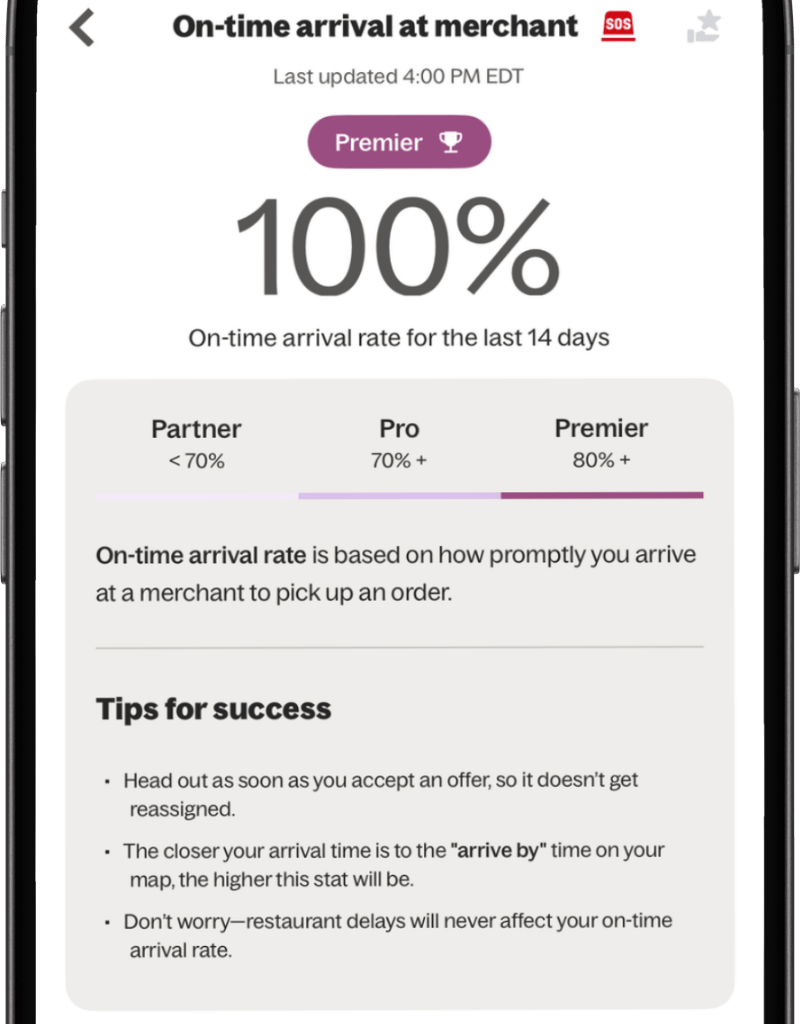
On Grubhub, they track your on-time rate during the course of 14 days, so instead of having to work off bad ratings, they track it by time.
And this doesn’t even account for the ezCater platforms, which not only account for you NOT showing up late, but also have rules for showing up too early, and some platforms won’t even let you move forward if you are too early, creating a safeguard within their platform.
Grocery and shopping apps such as Instacart or Walmart Spark are a whole different animal so we are going to focus on food delivery and catering delivery apps for the purposes of this article.

Two-Sides to “Being on time”
As we have mentioned, being on time has two different factors:
Pick-Up: being on time for the pick-up for the order
Drop-Off: being on time for the drop-off to the customer
Each platform handles this differently and some won’t let you be early, especially for scheduled orders such as for catering. Each platform seems to have a general window, anywhere between 5-15 minutes around the pickup time, to consider yourself “on-time”
That said, this rating has a lot of discourse for many reasons, so let’s take a look at some of the common arguments we see surrounding this rating.
Managing Independent Contractors
This is a metric that has been heavily disputed since we are independent contractors and it has been heavily criticized as a method of management commonly found within employee dynamics.
I have my own opinions on this concept.
On one hand as someone who prefers to be in business for myself, I do think that methods of micromanagement are a bit over-the-top at times and slow down the overall process.
But on the other hand, companies like this are going to rate us on this anyway, so letting us see the metric itself may be valuable to see and understand what each platform is seeing on their end.
However, that only applies if that was used for the purposes that they ACTUALLY present to us, and everyone knows that some of the methods that they use to track us, is either not as meaningful as they let on, or not influencing what they say they are or there is subtext or unspoken applications to those ratings.

For example, Doordash claims that platinum drivers will receive “more orders”, which may or may not be true, but more orders doesn’t mean good orders and “quality orders” in the eyes of Doordash is not the same as “quality orders” in the eyes of the driver receiving those orders.
And since Doordash also claims that on-time rating influences your order flow, and also contributes to platinum driver status, but it certainly is not the ONLY metric contributing to qualifying for platinum and if you don’t have the proper acceptance rate, it makes no difference.
That said, that doesn’t mean you don’t make an effort to show up on time, just don’t let them influence you into being concerned for your on-time rating being over any threshold that isn’t just maintaining minimum to keep your account active or your profit margins in general.
Violations vs Ratings
I don’t think this gets explained enough, especially since there has been a lot of back and forth for a while when they just got rolling initially (especially when my on-time rating literally broke on Doordash prior to my deactivation), but there is a distinct difference between a bad rating and a violation.
When you get a bad on-time rate, it affects your standing from the last 100 deliveries, which on some platforms you can work off, or you can dispute the rating within the app with no review.
When you get a contract violation, it affects your standing by creating its own section, which can also be worked off, or you can dispute it in the app and sometimes call in to have it removed by a supervisor (depending on if the support team actually does their job).
Regardless, just because you get a bad rating doesn’t mean you received a contract violation. Which can be a good AND bad thing depending on the platform.
Disputing Wrongful Ratings
Disputing wrongful ratings is easier depending on how hard you are willing to fight and how much you truly care about specific ratings of this nature.
I know I have spoken to many people on how they will dispute EVERY bad rating to maintain a perfect customer rating, but I haven’t heard anything about people fighting over the phone for on-time rating.
I know I have disputed on-time ratings in the app because it was easy to do so but it wasn't because I was willing to fight them over the phone for it. I have been willing to fight for a lot of things, but I haven’t been so desperate in the app to fight for that rating, at least not yet.
I have gotten pretty low on the app before on UberEats so maybe in the future this may be a problem but it isn’t a problem for me today.
Time Order was Placed vs Time Driver Accepts the Order
When I think of an order being rated for being “on-time”, there are a couple of things I think about:
The time the order was placed
The time a driver was assigned the order
While both metrics can have something to do with the other, there have been points of contention about whether or not the time a driver was assigned to an order has been fairly factored in when assigning poor ratings.
I can speak for myself on how I was marked for being late to a pick-up, even though I beelined straight to the pick-up location the moment I received an order and had no other real delays.
So I wonder if there is a gap between the point of “the order is running late because no one accepted the order yet” and “the order is running late because a driver hasn’t picked it up yet” that triggers at a different time frame than the rest of the other “factors”.
And if so, is that gap like 5 minutes past the point of expected time of order placed vs order acceptance and that is why I keep seeing “4 minutes late” when I haven’t even seen the order for 4 minutes? Or am I totally off base and there is a different factor entirely?
I would love to pick the brain of the software engineer who designed that side of the system, and see what factors are ACTUALLY included in this rating.
What about orders that have been sitting for an extensive period of time? Drivers refer to orders that have been sitting on the shelf for over an hour as the “shelf of shame” and when an order finally has enough value to accept it, should they have to fear taking a rating hit because they unknowingly took a no-tip order and it has been sitting for a while?
That driver probably walked in and was told “wow, you guys were an hour late huh?” Acting like the driver intentionally delayed the pick-up, when they didn’t even have the order yet.
What about ezCater orders that haven’t been assigned yet or had a no-show driver? Is that driver's rating going to be rated badly because a member of the RMDA doesn’t want to take accountability for having a bad driver or not finding a driver quickly enough?
I have heard from members of the RMDA such as Jeff Lago that their order flow does get affected by not assigning orders quickly enough or poor performance of the orders themselves.
What about for orders on UberEats, where there is no way for a driver to “mark themselves as arrived” and completely operate on a GPS system to dictate whether or not you show up?
I know I have definitely had problems with the app to where the GPS didn’t have the pin set right and they wouldn’t let me move on until I reached a physical location to slide that I am on my way, which is ridiculous but besides the point.
The point is that if you are going to create a system that determines whether or not you were on-time to the pick-up or drop off locations, the only timeframes that should matter in the eyes of the drivers effectiveness and rating are the timeframes in which they actually had been accepted and assigned the order itself.
Can you be Deactivated for Low On-time Ratings?
Many platforms have stated in their FAQ’s and contract agreements that drivers and shoppers can be deactivated for poor on-time ratings. That said, it is not immediate like it would be a violation in some cases.
Each platform has different standards, however if a driver is deactivated for bad ratings it is a lot more permanent than that of a standard violation.
Like having a really bad customer rating and on-time rating is a sign of poor performance, especially since the bar on this is actually pretty low, and easy to manage if you are doing your work correctly.
It is not as immediate and you have a lot of opportunity to improve. That said, that doesn’t mean you cannot be deactivated though, a lot of drivers have found they have been deactivated for far less, and with very little avenue to appeal.
I was deactivated on Doordash, and after 4 ½ years of appeals they finally said “oh, there was no violation” and reactivated me without an issue, and I maintained my ratings from prior to being deactivated.
Red Wagon Deliveries had lied about why I was deactivated claiming “ezCater said so” and by the way, Heather Rideaux told me I needed to apologize to ezCater, gaslighting me into thinking exposing the RMDA for condoning tip theft with JackRabbit Deliveries was “fundamentally wrong. “
The point is, if they want to get rid of you, they will and good luck fighting back.

And that was one of the reasons I became so interested in accountability within catering deliveries. There are simply too many moving pieces between the restaurant, the dispatcher, the driver, and the customer.
When something goes wrong, it's often difficult to determine where the problem actually started, which is why I created the ezCater Tip Verification form. If you've ever experienced a questionable tip payout or another issue with one of your catering deliveries, you can submit it through the form.
The goal isn't to point fingers—it's to help document potential issues, identify patterns over time, and encourage greater transparency throughout the catering delivery industry.
Real World Experience vs Data Theory
One thing I would like to point out is how you can tell the difference between a system fix based on real world experience and which systems are based on data theory.
Which fix to the system has been made from the perspective of someone who has been conducting deliveries and understands the system on a fundamental level, or someone who has been sitting in a back office, pretending to understand how everything works.
The one thing I would like to highlight in this case is how Doordash has the WeDash program mandating that every office employee (including executives such as Tony Xu, and the engineers operating the app itself) must make deliveries as an employee of Doordash.
Meaning they would have to have a firsthand perspective on the delivery experience. However, there is the point that is constantly brought up on this subject:
How much experience does one delivery a month actually give you in order to effectively fix the system? And are you fixing the system in a way that is helpful for drivers or for the profitability of Doordash as a company?
To be fair though, it is better than no experience at all but it is still worth considering the intentions of the program itself.
Is Being Too Early a Problem?
So this is one of the most interesting points on this matter because from the perspective of most companies, they want you on site early so you can be on-time, but that doesn’t mean you should and that doesn’t mean they would pay you for doing so.
I have spoken to many managers in W2 jobs where they instruct employees to be there early so they can "clock in on time”, but that doesn’t mean they will be paid for that time.
From a driver's perspective, showing up too early for a pick-up means you are standing in the restaurant waiting for an order to be completed, only to miss out on more orders you could have accepted in the meantime.
And if it is a catering pick-up, some apps punish you, or just straight up won’t let you show up early in a way that you can mark yourself as arrived.
Skipcart is a great example of an app that forces you to be early, and then punishes you either way. They kick off your navigation to the pick-up location within the app 45 minutes before pick-up time and you can only be about 15 minutes early.
Which means if it takes you less than 30 minutes to go from where you are to where you need to pick up the order, you have to wait in your car until they let you mark yourself as arrived, that doesn’t mean the order is ready, you just arrived.
Doesn’t matter if the order is an hour away or a block down the road.
And if you don’t get moving right away when they start navigation, they bombard you with texts, notifications and otherwise every 5 minutes and then they take the order from you. Meaning if you want to get paid for that order, you don’t have a choice because they forced your hand as soon as navigation started.
I understand not wanting to mess with ezCater in that way because I know a lot of these companies are intimidated to do so, but that doesn’t mean you literally steal time, energy and effort from a driver when they can be earning in the meantime.
How Tips Affect Being “On-Time”
Tips truly are the make or break of why an order will be late to its destination. A no-tip order on a fundamental level is inherently less valuable than an order with a tip from a ratings perspective, from an earnings perspective and account safety perspective.
So when drivers see a bunch of orders without a tip, we call it the “shelf of shame.”

When an order is declined enough, the order's value is raised until someone finally accepts the order. And surprise surprise, the restaurant owner asks the driver what took them so long to get there.
This is what I like to call a customer's “self-inflicted lateness”. Every customer who doesn’t tip will blame everyone else but themselves for why an order was late, and every driver will know to steer clear of them entirely.
The driver may also receive a poor customer rating which may not be excluded because they may not provide an explanation in the app, the system will mark them as late to the drop off, and if the customer has even less character, they will use this information, exaggerate it, get a refund and give the driver a violation in the process.
Say what you will, but customers who choose not to tip their drivers on the app when the order is placed, go through the system in a way that they brought upon themselves.
Delays at Pick Up
I find that some places have this issue worse than others, but what I have found the most interesting is how often I find restaurants are the reason the order is delayed to the drop-off.
Most companies will swear up and down that it won’t affect your ratings, but I have seen my ratings affected by delays and in some cases it affects my whole day.
Imagine stacking 2 catering orders back to back, staying within the boundaries of each platform and because one douchebag lost a receipt, or swears up and down that they didn’t receive it BUT they can “rush” it and know the details of the order we don’t, or they received so god-damn many orders in the first place that they can’t finish your order on time, then not only this order is late, but the following order is late too.
And because of that, your stats as a driver have been greatly affected not only on the platforms but on your ability to conduct orders at all for the next few days.
I have had many instances where I had that issue, and because of that my whole income stream from catering orders was affected for the following days after.
That doesn’t even account for food delivery incidents such as deprioritization of food delivery orders in the kitchen, delays in the order itself or just straight negligence by staff members in the restaurant.
Either way, drivers shouldn’t be penalized for issues outside of their control.
Should there be an “On-time rating” for Pick-Up Times?
There have been a significant number of people (including myself) who have made the point of not having an on-time rating for pick-up times, because it shouldn’t matter what time we get to the restaurant, if we are on time to drop off the order to the customer.
Which I can see the point of saying something like that but let’s also look at the other aspects of this argument.
We can tell if an order has a delayed pick up for over an hour because a customer didn’t tip, the ambiguity of the driver being the problem is a moot point because they know you were on time when you got the order, and the order was picked up as soon as you got there.
We can tell an order was delayed by the restaurant because you showed up there on time, and stood there waiting for them to finish it before you can leave.
Not to mention having an on-time rating also discourages people from picking up the order late and driving wildly and unsafely to drop off orders.
So there is a point, but is it a good enough point? Let me know what you think in the comments.
Best Practices for Protecting Your On-Time Rating
At the end of the day, your on-time rating is another metric that can influence your standing on many platforms. Whether you agree with how it's calculated or not, it is still something worth paying attention to. Here are a few habits that can help protect both your account and your earnings.
Learn Which Restaurants Consistently Cause Delays
Every market has restaurants that are almost always running behind. Over time, you'll start to recognize the places that regularly keep drivers waiting. That doesn't necessarily mean you should avoid them completely, but knowing what to expect allows you to make better decisions when accepting orders.
I have a couple of restaurants on my “no-go list” and even though a lot of these platforms say they don’t affect my ratings, I still end up disputing a bunch especially on Doordash.
Report Delays Whenever the App Allows It
Many platforms provide options to report that the restaurant is still preparing the order or that there is another delay outside of your control. While this may not always prevent a rating from being affected, it creates a record that you encountered an issue and provides additional context to the platform.
I almost always say traffic because that is really what it boils down to but remember that Doordash specifically only allows you to exclude up to 10 ratings at a time, so you would have to wait until one of your exclusions gets removed before you dispute another.
Don't Try to "Make Up Time" by Driving Aggressively
No delivery is worth risking an accident, a ticket, or your own safety. If an order is already running behind due to factors outside your control, speeding or driving recklessly usually isn't going to solve the problem. Focus on delivering the order safely instead.
I know how frustrating it can be especially when you are already running late and you end up behind the slowest grandma in the world, but in trying to drive around them aggressively it is also possible you can end up being the accident on the side of the road to make even more traffic because of it.
Be Careful with Overlapping Orders
Running multiple apps can be a great way to increase your earnings, but only if you're managing them responsibly. Accepting overlapping deliveries that you realistically cannot complete on time increases the risk of late deliveries across multiple platforms. Know your limits and don't let one payout jeopardize your account.
This is what I like to call “dirty multi-apping” and is usually more of a risk than a reward.
Don't Obsess Over Every Single Rating
One bad on-time rating isn't the end of the world. Most platforms use rolling averages or evaluation periods, meaning isolated issues usually work themselves out over time. It's much more productive to focus on consistent habits than chasing a perfect percentage.
Also for drivers looking to be part of higher programs such as platinum rewards, make sure you aren’t accepting lower quality orders that increase acceptance rating, only to hurt your other ratings.
Remember What You Can—and Can't—Control
Traffic, restaurant delays, long dispatch times, GPS issues, and customers who leave no tip are all realities of gig work. Focus your energy on the parts of the job you actually control: communicating professionally, arriving promptly after accepting an order, delivering safely, and documenting issues when they arise.
By building good habits instead of chasing perfect numbers, you'll generally protect both your account and your peace of mind much better in the long run.
Does This Discourage Multi-Apping?
Having the on time rating within each of these platforms also discourages drivers from multi-apping in a way where the driver is carrying multiple orders on multiple platforms.
While you could and should be active on multiple platforms, taking overlapping orders on platforms can and will punish you if you aren’t careful. It’s one thing to “be online” for other apps, it is another to delay orders because you THINK you can pick up another order quickly enough.
So I can understand people feeling discouraged from trying to pull off some “dirty multi-apping” for that reason.
However, it is also worth mentioning that just because we are on multiple platforms, doesn’t mean we shouldn’t look for ways to earn outside of gig work.
Make sure you are looking out for your financial stability because no one is looking out for your financial future and safety better than you are.
Final Thoughts
Look, as much as I hate the metric from the perspective of the driver, it is necessary from the perspective of the platform and frankly, they don’t have to show us.
They can absolutely track this quietly and we would just have to be okay with it or never know the difference.
Does it have to be attached to metrics that influence rewards platforms, no. Is it better to “not be rewarded” for latenesses rather than to be punished, I think it is a matter of perspective.
In any case, this is a necessary metric that is here to stay and it does affect your platform eligibility so make sure to keep it high for your own sake.
The problem isn't that platforms measure whether drivers are on time. The problem is making sure drivers are only judged for the time they actually control.
If you would like to add some other perspective to On-time ratings on different platforms, feel free to email me: drivenwyld@gmail.com and who knows? Maybe your email or perspective and be featured in a post as well!


Comments