


.png)
On-time Arrival at Merchant Rate on Grubhub - EVERYTHING You MUST Know!!

Grubhub's On-time Arrival at Merchant Rate is one of the most unique ratings in the gig economy.
While I wouldn't necessarily call it a better system than DoorDash or Uber Eats, there are parts of it that I think are significantly fairer to drivers—and even make more sense given Grubhub's current market position.
So in this video, We are talking about:
EVERYTHING You MUST Know about the On-time Arrival at Merchant Rate on Grubhub
What they tell you vs How it ACTUALLY is
Everything in between!
Disclaimer: The content of this video does not contain and is never intended to be legal, business, financial, tax, or health advice of any kind. This video is for entertainment, educational, and informational purposes only. It is advised that you conduct your own research and consult with qualified professionals before applying anything you find online.
I also want to be clear that everything we are going to go over is very market dependent, and what applies to me and my market may not apply to you.
What Grubhub Tells You
First of all, I find it kind of interesting that finer details about the On-Time Rate is VERY MINIMAL on the Grubhub Driver Help Pages.
Everything Grubhub tells drivers about this rating fits into just a handful of sentences—and unfortunately, it leaves out most of the questions drivers actually have.
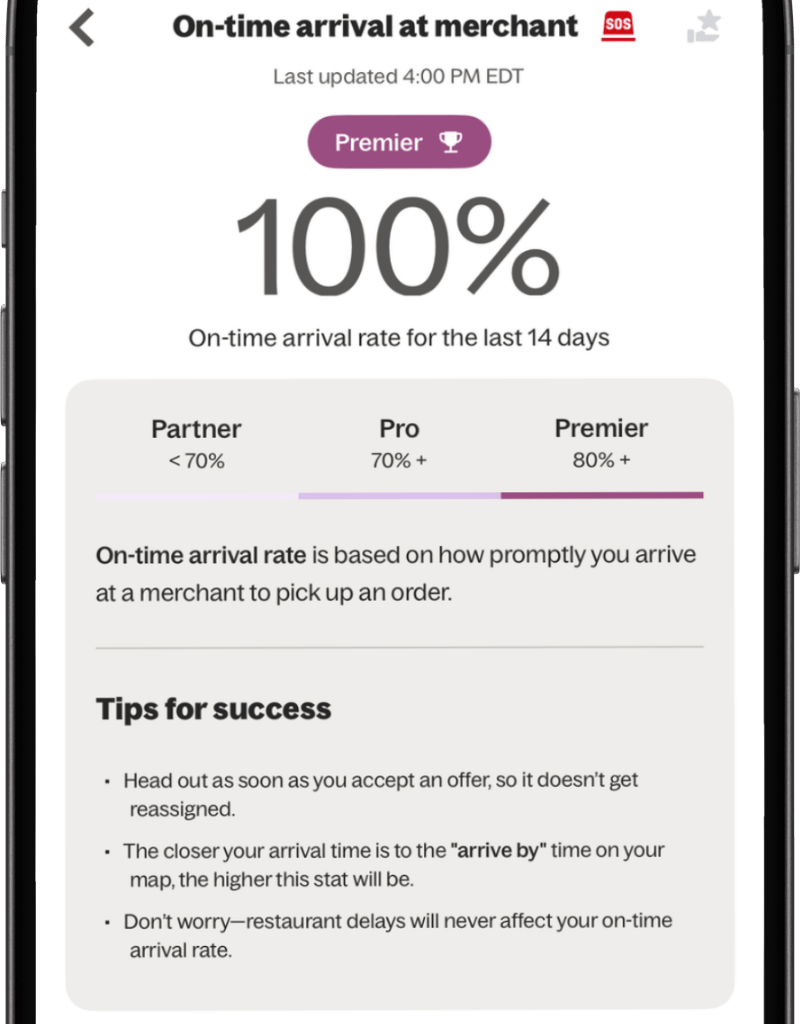
Your on-time arrival at merchant rate is calculated based on how promptly you arrive at a restaurant or merchant to pick up an order.
Suppose you accept a $14 Grubhub order that's asking you to arrive at Chick-fil-A by 6:20 PM. If you pull into the parking lot at 6:18 and mark yourself as arrived, you're on time.
If traffic slows you down and marks yourself as arriving at 6:25 instead, your On-time Arrival at Merchant Rate could take a hit because you missed that target.
This is already different from DoorDash and Uber Eats because this rating only measures the first half of the delivery process and it is the one rating in which the outcome is largely within your control.
I get that this is a very straight forward concept from a surface perspective, but GOD DAMN, can we maybe answer the questions drivers are actually going to ask five seconds after reading this??
It is the same help page that JustEat Takeaway had, probably when they bought Grubhub initially, but I thought that when Wonder bought the company they would try to revamp some of the help pages and systems.
A tip for success: head out as soon as you accept an offer, so it doesn’t get reassigned.
Also one of those “no duh” kind of tips, like super minimal and definitely not really that helpful for someone who would like to understand how the rating is truly tracked, this is the only “tip” in the help pages.
There are a couple of tips in the “On-Time Arrival at Merchant Rating Page” available in the Grubhub ratings section in the Grubhub Driver app.
The closer your arrival time is to the “arrive by” time on your map, the higher this stat will be.
Again, pretty much straight forward. However a lot of people have contested this point by questioning how the “arrive by” time is determined. Is the “arrive by” time determined by when the order was placed or when the driver accepted the order?
That distinction matters because drivers don't control when the customer placed the order—they only control what happens after they receive the offer.
There is a lot of debate on this, not only for the overall purposes of On-time ratings in general but if an on time rating for arrival to the pick up location should exist at all.
Don’t worry—restaurant delays will never affect your on-time arrival rate.
This might actually be the one great thing about this rate, because it is not the on-time rate to the customer, or both the merchant and customer, but the on-time rate for the merchant ONLY.
Meaning that every aspect of getting to the merchant location is almost completely within your control.
Now let's say you made it to Chick-fil-A at 6:18 like the app asked, but the restaurant tells you it'll be another 25 minutes before the food is ready. That's frustrating—but it doesn't hurt this particular rating because Grubhub only cared that you got to the merchant on time.
Granted that doesn’t change that traffic can slow you down, and road blocks as well as other obstacles can slow you down as well, but nevertheless the MAIN obstacles that would affect your rating on other platforms, is not a factor here.
It doesn’t matter if the customer puts in the wrong address, or the restaurant chooses to delay the order, only if you made it there on time.
That doesn’t mean you should tolerate poor behavior from customers or restaurants, but at least know that if you do arrive on-time to the merchant, you won’t be penalized for what happens after, at least in this rating specifically.
So now that we understand how the rating is actually calculated, let's talk about why drivers care about it in the first place.
How “On-time arrival at merchant” rate affects Premier Status
On-time rate is one of the three ratings that directly affect your status as a driver in terms of your placement in the Driver Recognition Program on Grubhub.
<70% On-time rate is partner level.
70%+ is Pro
80%+ is Premier.
Now to be clear, this rate is only as good as your lowest placement. So if ONE of the placements you have is below the highest, that is the level you will stay at.
Honestly, I would focus more on maintaining good habits and making a profit rather than trying to keep up with this program but do what you wish.
On-time Arrival at Merchant Rate is Not Offer Commitment Rate
Like I said, the On-time arrival at merchant rate only affects… well how often you are on time to the merchant. Offer commitment rate is how often you follow through on the orders you accept front to back, regardless of how fast or on time you will be.
So while your rating for being on time may not be affected if you decide to unassign when getting to the restaurant, you can experience a hit to your Offer Commitment rate.
Let's keep following our Chick-fil-A order. You arrived on time, but after waiting 20 minutes you decide the wait isn't worth it and unassign the order. Your On-time Arrival at Merchant Rate may still reflect that you arrived when expected, but your Offer Commitment Rate can still decrease because you accepted the offer and didn't complete it.
There are nuances and reasons to assign for sure, but nevertheless if you are the type of person who is very concerned for their ratings, this is an important distinction.
Understanding that distinction is important because it also helps explain another thing that makes Grubhub's system unique—how long these ratings actually stick around.
Ratings Attached to Time, Not Orders
One of the notable things about the On-time rating for Grubhub is that the rating is based on how often you were on-time over the past 14 days. So if you take an order, were late once and didn’t do a single order since, the order kind of just falls off after 2 weeks.
Fast forward two weeks. Suppose this Chick-fil-A order was the only one where you arrived late during that time. Once it falls outside Grubhub's 14-day tracking window, it no longer affects your On-time Arrival at Merchant Rate.
This is very different from the On-time ratings you would find with Grubhub’s competitors, Doordash and UberEats, where they are based on the last 100 deliveries on a rolling basis.
This might actually be a good thing though, especially for a platform that doesn’t have the volume of Doordash and UberEats. It kind of gives us an opportunity to maintain at least one solid rating as long as Grubhub does their best to take back the position they once lost.
Should There be a Rating for This?
I completely understand why some drivers hate this rating—but I also understand why Grubhub uses it. As I said earlier, there are a lot of questions on whether or not there even should be a rating on the concept of showing up to the merchant on time.
Is it not more important to get the order to the customer in a timely fashion?
Why would we be rated on the first half of getting an order completed and nothing else?
Is this not just a method of micromanagement by the people operating the platform?
First off, I would rather be rated on things I can control and one of the things I have the most control over is being on time to the merchant. Again, there are edge cases in traffic and such but for the most part, this is the one step I have the most control over compared to the rest.
Looking at our Chick-fil-A example, I actually understand why Grubhub tracks this. Whether I got there by 6:20 was almost entirely under my control. Whether the restaurant took another 25 minutes wasn't. If I'm going to be judged on something, I'd rather it be the part of the delivery I have the most influence over.
Second, while I agree it is more important to get the order to the customer on time, there is a huge difference in the overall purpose of the delivery and the ways in which we are rated. Grubhub is one of the platforms that kind of ONLY rate us on things we can control.
And finally, is it a form of micromanagement? I think in terms of each of the big three, it may be not only the least suspect of using ratings as a management system, and more so using them to have drivers qualify for higher paying orders through their Driver Recognition Program.
I still don’t think it is worth losing money just to get a couple of bigger orders, but you do you.
In other words, there is a very big difference between “being punished by ratings” and “not being rewarded for ratings”.
Don’t Risk Dirty Multi-Apping
One thing I would say regardless of the platform, especially today where companies have been cracking down on it, is not to risk dirty multi-apping where you are trying to complete multiple orders on multiple platforms.
While you could and should be active on multiple platforms, taking overlapping orders on platforms can and will punish you if you aren’t careful. It’s one thing to “be online” for other apps, it is another to delay orders because you THINK you can pick up another order quickly enough.
Now imagine that before heading to Chick-fil-A, you accepted an Uber Eats order from the restaurant next door because you thought you could squeeze both deliveries in. That extra stop causes you to reach Chick-fil-A at 6:24 instead of 6:18. Suddenly you've created a problem that didn't need to exist—and potentially hurt your standing on multiple platforms.
Not only do you risk getting the bad rating, you also risk having multiple contract violations on each platform, or worse getting deactivated, especially in California or NYC where overlap can get you in trouble.
Remember, diversifying your income is supposed to reduce risk, not give you more.
Final Thoughts
This rating seems to be the most interestingly executed out of the big 3 food delivery companies and while I do like a lot of things from it and some parts of the Grubhub system work well considering their circumstances, there are also the parts that should be executed a bit better.
There is no real dispute system within the app, or anywhere else.
If there is a problem getting to the merchant, what actions should a driver make? Doesn’t say on the help pages and we can’t just assume that support will help us when they haven’t been all that helpful in the past.
What are the minimum requirements? Are there minimums or is it just “if we don’t want you, we will cut you rules?”
Like I said, the help pages don’t answer those questions which, unfortunately, were the exact questions everyone had five seconds after reading the first paragraph.
At the end of the day, I actually think Grubhub's idea isn't the problem. The problem is that drivers shouldn't have to reverse-engineer how it works.
Good documentation creates better drivers. Guesswork creates frustration. The more drivers understand how these systems actually work, the better decisions they can make—not just on Grubhub, but on every platform they use.
If you would like to add some other perspective to the On-time Arrival at Merchant Rate on Grubhub, feel free to email me: drivenwyld@gmail.com and who knows? Maybe your email or perspective and be featured in a post as well!


Comments